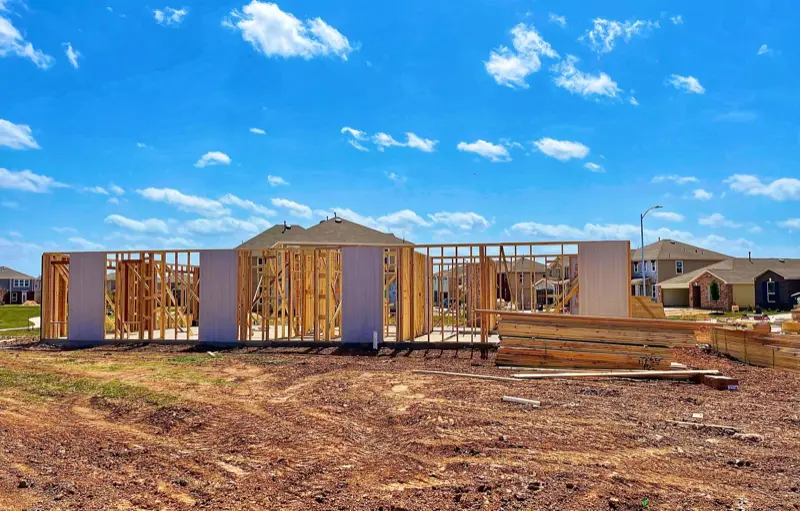
If you are thinking about co-investing in a new-construction home in California — through Subworkit's real estate co-investment program or any other path — you need to understand how a construction loan actually works. The math is simpler than most lenders make it sound, but the structure of the loan is very different from a regular mortgage.
What is a Construction Loan?
A construction loan is a short-term loan (usually 12 to 18 months) used to fund the building of a new home. Unlike a mortgage, the lender does not give you the full amount up front. Instead, the loan is divided into draws that are released as the project hits milestones: foundation poured, framing complete, roof on, drywall, final.
You only pay interest on the amount that has been drawn — not the full loan principal. This is the single most important thing to understand. It is why construction-loan interest costs are usually far lower than people expect.
How Interest Is Calculated
The simplified formula:
Interest cost ≈ Total loan principal × Annual rate × (Months / 12) × Average utilization
Average utilization is the fraction of the loan that is drawn at any given time, averaged across the build. If the loan is fully drawn at month 1 and held to month 14, utilization is 100%. If the lender releases roughly equal draws across the build, the average utilization works out to around 50%.
Real Example
Take a 1,850 sqft single-family home in Oceanside, CA, built at $250 per square foot wholesale, with $70,000 in soft costs (permits, architecture, water meter, fire marshal):
- Loan principal = $462,500 + $70,000 = $532,500
- Rate = 10% annual (typical mid-2026 California construction-loan rate for an experienced GC)
- Build period = 14 months
- Average utilization = 50%
Interest = $532,500 × 0.10 × (14 / 12) × 0.50 = $31,063
That is the total interest cost over the entire build. Not per month — total. On a $1.15M project where the home sells for over a million dollars, $31k in interest is a very small line item.
Why the Investor Does Not Sign on the Construction Loan
In Subworkit's co-investment structure, the investor takes title to the land and fronts the cash for permits — $245,000 total in the Oceanside example above. That is the investor's only cash outlay.
The construction loan is taken out against the land equity by Subworkit Contracting (CSLB License #945572). Subworkit handles all draw paperwork with the lender. The investor never writes a check to a subcontractor. The interest cost is part of the project basis and is subtracted before the 80/20 profit split.
What Could Go Wrong
Construction-loan rates can move during the build. If rates rise from 10% to 12% mid-project, your interest cost on the same example goes from $31k to $37k — about $6k difference. That is real but it is not a project-killer on a $1.15M sale.
The bigger risks are permit delays (which extend the project timeline and stack up more interest) and cost overruns (subcontractor pricing volatility on lumber, copper, concrete). A licensed general contractor who has done this many times before is the single biggest mitigator of both risks.
Run Your Own Numbers
The Subworkit real estate investment calculator lets you adjust the loan rate, project months, and average utilization to see exactly how the construction-loan interest changes. Drop in your own numbers — the calculator updates instantly.
For more on the full investment structure including the 80/20 profit split, the 1% Realty rebate on land + sale, and the 10% wholesale construction discount, see our How to Invest in Real Estate Safely page.
Disclaimer
This article is informational only and does not constitute financial, legal, or tax advice. Always consult a California-licensed real estate attorney and a CPA before committing capital to any real estate development project.
Ready to Start Your Project?
Contact Subworkit Contracting today for a free consultation. We serve San Diego County.